
Are you shopping for a new swimsuit?
Shop no more.
The most remarkable swimsuit in the world is already yours.
It costs nothing. It never wears out. It never goes out of style. It fits every age, every shape, every size, and every body exactly as it is.
It does not squeeze, cling, sag, ride up, dig in, bunch, chafe, stretch out, fade, or hold cold water against your skin.
It leaves no awkward tan lines. It needs no brand label, no flattering cut, no changing room negotiation, no cover-up strategy, and no quiet little argument with the mirror before you get in the water.
It lets your whole body feel the water.
It lets your whole body feel the sun.
It lets your whole body dry naturally, evenly, and comfortably.
It gives you the freedom to swim, float, sit, stretch, move, and simply be in the water without wearing a damp synthetic reminder that your body is supposedly something to manage.
And the best part?
You were born with it.

The Strange Problem with Swimsuits
Most of us were taught to think of swimsuits as normal.
Not optional. Not cultural. Not a design choice. Just normal.
You go swimming, so you put on a swimsuit. That is the rule.
But when you pause long enough to question it, the rule starts to look strange.
A swimsuit does not make ordinary recreational swimming more comfortable. For many people, it does the opposite. It clings when wet. It squeezes soft places. It highlights some areas while hiding others. It turns getting in and out of the water into a performance. It makes people tug, adjust, cover, compare, and worry.
- Is it flattering?
- Is it too revealing?
- Is it too modest?
- Does it cover enough?
- Does it show too much?
- Can I sit like this?
- Can I walk across the pool deck without feeling inspected?
For a lot of people, swimming stopped being simple because the swimsuit became part of the test.
And the strangest part is this: the swimsuit is usually treated as the thing that protects dignity.
But what if it often does the opposite?

The Swimsuit Does Not Remove Body Shame
A swimsuit does not erase shame. It often organizes it.
Once the body is treated as something that must be selectively covered, the covered areas become charged with meaning. The swimsuit does not remove attention from the body. It directs attention. It divides the body into zones: acceptable, unacceptable, revealable, concealable, flattering, embarrassing.
That division is where much of the tension begins.
Nudity presents the body as a whole. Swimwear often breaks the body into parts.
This does not mean every person wearing a swimsuit is trying to be sexual, fashionable, or performative. Most people wear swimsuits because that is the only socially permitted choice. They are simply following the rule.
But a garment can still shape how a body is seen.
A swimsuit can be socially required as “modest” while also making the body more visually framed, inspected, and judged than ordinary non-sexual nudity.
That is the contradiction.
The thing we call modest may be the very thing that makes the body feel more exposed.
For the deeper foundation behind this argument, read: “The Body Parts We Refuse to Normalize.”
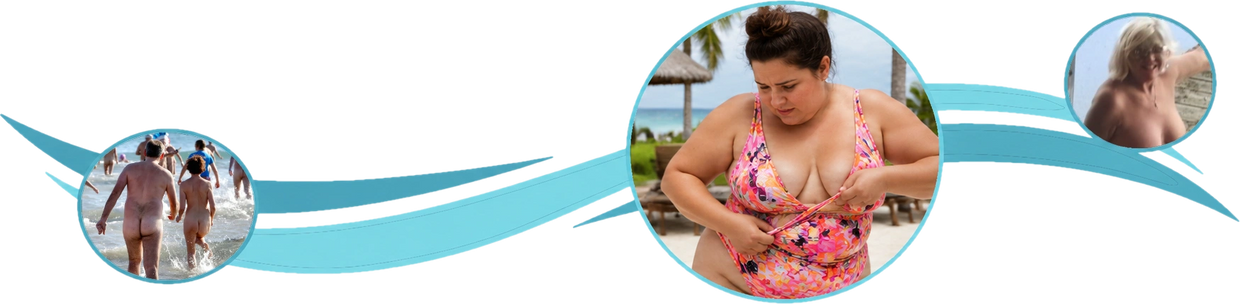
Swimming Was Not Supposed to Feel Like a Test
Swimming should be one of life’s simplest pleasures.
Water on skin. Sun on shoulders. Movement without heaviness. Floating without effort. The small, animal happiness of being held by water.
But for many people, the experience is crowded by self-consciousness before they ever step into the pool.
The problem is not that swimsuits exist.
The problem is that one cultural garment became the price of admission to one of life’s simplest pleasures.
And when that garment makes people feel squeezed, judged, displayed, or ashamed, it is fair to ask whether it is really serving them.
For many people, the most comfortable swimsuit is no swimsuit at all.
Not because the body is shocking.
Because the body is ordinary.
Because skin belongs in water.
Because comfort matters.
Because dignity does not come from fabric.

The Body Is Not the Problem
Human body norms change.
What a culture calls decent, normal, respectable, or shameful is not fixed in the body itself. It is built around the body.
At different times and in different places, people have treated bathing, modesty, clothing, and nudity in dramatically different ways. These rules can feel eternal when we grow up inside them, but they are not eternal. They are learned.
That matters because learned shame can be unlearned.
If your own body feels embarrassing to you, that does not mean your body is wrong.
If seeing an ordinary naked body feels automatically indecent, that does not mean the body is indecent.
It may simply mean you inherited a rule so early and so deeply that it now feels like reality.
But the body came first.
The shame came later.

What Changes When the Swimsuit Comes Off
For people who discover clothes-free swimming in a safe, respectful, non-sexual setting, the surprise is often not how radical it feels.
The surprise is how quickly it can feel normal.
The water feels better.
Movement feels easier.
Drying off feels simpler.
The body feels less divided.
The constant little negotiations disappear: the tugging, adjusting, covering, checking, comparing.
Nothing has to be shaped into acceptability.
Nothing has to be disguised before it is allowed to exist.
You are simply a person in the water.
That simplicity can be powerful.
Not dramatic. Not rebellious. Not a lifestyle requirement.
Just better.

This Is Not About Forcing Anything
The point is not that everyone must swim without a swimsuit.
The point is that no one should have to believe their body is shameful in order to go swimming.
Swimsuits can be useful in some settings. They may be required by law, policy, comfort, weather, safety, or personal preference. People should be free to wear what feels right for them.
But that freedom should include the freedom to question the assumption that fabric equals dignity.
Because dignity is not stitched into a garment.
Dignity is already present in the person.
The World’s Best Swimsuit
The world’s best swimsuit is not sold in a store.
It is not hidden behind seasonal trends, body-type advice, or dressing-room dread.
It does not ask whether you are beach-ready.
It does not ask whether your stomach is flat enough, your thighs are acceptable, your chest looks right, your skin is smooth enough, or your body has earned permission to be seen.
It is already yours.
It is your own body, whole and human, made for water long before swimwear became a rule.
So maybe the real question is not:
“Which swimsuit should I wear?”
Maybe the better question is:
“What would swimming feel like if I did not have to wear my shame?”
For some people, the answer is simple.
It feels like freedom.
It feels like relief.
It feels like coming back to the body you had before the world taught you to apologize for it.
