
Why Simply Swimming Naked Can Feel So Complicated
Some people discover this idea and think:
Yes. Swimsuits do sound weird. I can imagine that swimming without one might feel simpler, freer, and more natural.
And then, because of the society most of us were raised in, another thought arrives almost immediately:
But that sounds like nudism.
And nudism sounds like a lot.
That reaction is understandable.
For many people, “nudism” does not sound like simply removing a swimsuit before getting in the water. It sounds like a whole social world: nude volleyball, nude camping, nude dinners, nude games, nude walking paths, nude events, nude communities, and maybe even a lifestyle identity.
That can feel like a much bigger step than simply swimming.
But the deeper issue is not only swimsuits.
And it is not only nudity.
It is how uncomfortable many of us have been taught to feel with the very body that carries our life.
The body that breathes.
The body that moves.
The body that feels water and knows sunlight.
The body that carries awareness, memory, vulnerability, love, play, rest, and joy.
Swimming makes that discomfort visible.
Water should invite ease.
But culture often adds fear.
A person may be curious about swimming without a swimsuit and still not be ready to spend a day, a weekend, or a vacation in a fully nude social setting.
They may not be trying to make a commitment.
They may not be looking for a new label.
They may not be ready to join a community.
They may just want to try a simple swim.
It does not mean they are anti-nudist.
It may simply mean:
I just want my body to feel normal.
I want relief from body alienation.
I just want to swim.
That is one of the reasons Feel Good Swimming exists.
Just swimming without a swimsuit should not have to begin with a club membership, a philosophy, a social label, or a whole new way of life.
It can begin with one small, ordinary question:
What would swimming feel like if the swimsuit was not in the way?
For many people, the desire is not complicated at all.
They want to enjoy a pool, beach, lake, river, spring, or swimming hole the way they enjoy a shower or bath: with nothing between their skin and the water.
Not as a philosophy or lifestyle.
Just skin, water, movement, air, sunlight, and ease.
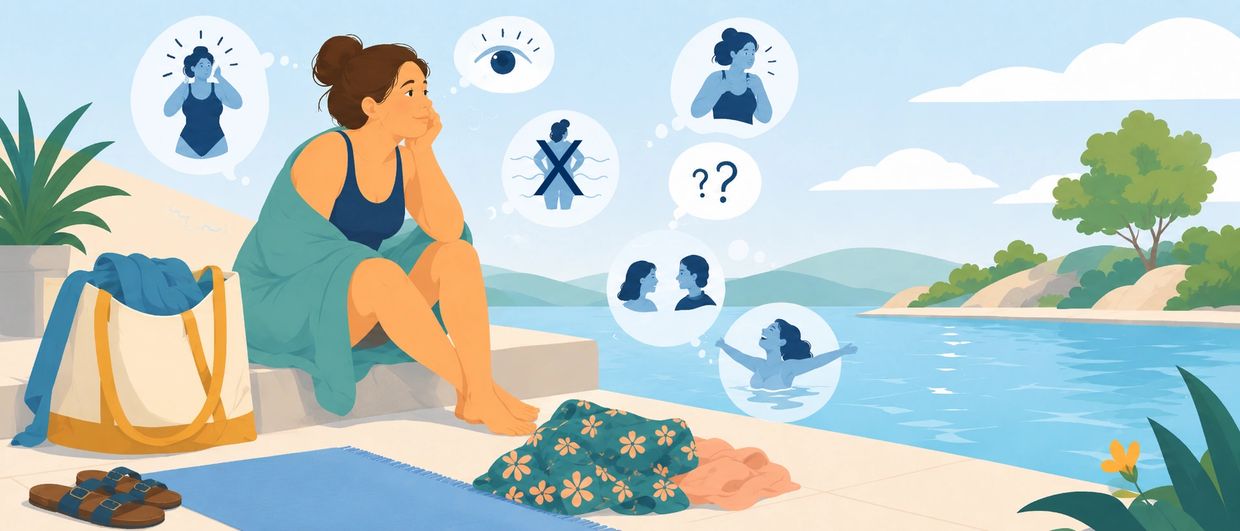
The Wish Is Simple. The Culture Makes It Complicated.
Here is the reality:
A person can agree with the entire idea and still not have an obvious place to swim without a swimsuit.
That is not a failure of the person.
It is part of the cultural structure we live inside.
In a culture that mostly permits nudity only for bathing, sex, or medical care, something as simple as swimming without a swimsuit becomes tangled in law, privacy, money, geography, shame, safety, social risk, and misunderstanding.
That is why nudist clubs, naturist resorts, clothing-optional beaches, hot springs, private pools, and established organizations can be very valuable.
They often provide legal, safer, better-understood places where people can experience ordinary nudity without shame. Many people become more relaxed, respectful, and at ease with their own bodies and other people’s bodies in those settings.
That matters.
Still, for many people, going from no nudity outside the shower to the idea of doing many everyday things nude can feel like too much at once.
Not because the people there are doing anything wrong.
But because the culture most of us were raised in made ordinary nudity feel like a cliff instead of one small, ordinary choice.
Feel Good Swimming is interested in that ordinary choice.
For the person who is not looking for a lifestyle change.
For the person who does not want to make a statement, travel to a club, join a movement, or explain a philosophy.
For the person who simply wonders whether swimming might feel better without a tight, wet, body-conscious garment wrapped around the experience.
That person deserves a gentler way to begin.
Because swimming is an “ing,” not an “ism.”
You do not have to know what label fits you.
You do not have to decide whether nudism is for you.
You do not have to want nude camping, nude tennis, nude dinner, nude volleyball, or nude anything else.
You may simply want to swim.
And that is enough.

The Symptom Is Not the Subject
Swimsuits are part of the story.
Nudity is part of the story.
But neither one is the whole subject.
The deeper subject is the way many people have been taught to distrust the body itself.
Not just one body part.
Not just one garment.
Not just one rule.
The whole living body becomes something to manage, cover, compare, correct, apologize for, improve, inspect, and worry over.
That is a strange thing to do to the body that lets us experience being alive.
The body is not a costume for shame.
It is how a person meets the world.
It is how we feel water, sunlight, cool air, warm towels, movement, buoyancy, rest, laughter, and relief.
When swimming becomes tangled in body shame, something has gone wrong.
Not with the body.
With the story we were handed about the body.
For ordinary swimming, the swimsuit simply does not solve the body problem. It keeps the body problem alive — clinging, squeezing, dragging, shifting, and asking to be adjusted while pretending to provide dignity.
That is why swimsuits become one very visible symptom of the story.
The panic around ordinary nudity is another.
The awkwardness many people feel around genitals is another.
But the subject underneath all of them is human dignity.
A person’s dignity is not created by fabric.
A person’s dignity is already present because a person is present.
So the question is not only:
Can I swim without a swimsuit?
The deeper question is:
What would it feel like to enter the water without treating my body as a problem first?
But Real Places Matter
At the same time, we have to be honest about the world we live in.
In our current culture, there are not many easy, legal, socially understood places where a person can simply just swim without a swimsuit.
That is why real-world options matter.
Private home swims, nudist clubs, naturist resorts, clothing-optional beaches, hot springs, and carefully hosted swim gatherings are not all the same.
They do not all serve the same person.
They do not all feel equally comfortable, accessible, affordable, or safe.
And no single option is perfect for everyone.
But they are real choices that are of value.
They can make what should be one small, ordinary step toward comfort more attainable.
The goal is not to force yourself into the biggest or boldest choice.
The goal is to find an option that fits where you are now.

Private Home Swims
For many people, the gentlest choice would be a private swim with a trusted person, couple, family, or small group.
There are millions of private pools, a clear advantage over other options on this list.
A private pool can lower the pressure.
There may be no strangers, no public setting, no long drive to a resort, and no need to enter a larger social world before you are ready.
That can make a simple swim feel simple again.
But private swims also require care.
There must be clear expectations, clear consent, clear privacy, and clear behavior standards.
No one should be pressured.
No one should be surprised.
No one should be photographed without explicit permission.
No one should have to manage someone else’s awkward behavior.
A good private swim is not casual in the careless sense.
It is casual because the setting is relaxed.
It is respectful because the boundaries are clear.
Private home swims may eventually become one of the most important ways to begin for Feel Good Swimming, especially for people who are curious but not ready for a club, resort, or beach.
A simple invited swim can say:
This does not have to be a big production.
It can just be swimming.
But if you don’t have access to an appropriate private pool, here are some other options…

Nudist Clubs and Naturist Resorts
Nudist clubs and naturist resorts may sound intimidating to someone raised in this culture.
That is understandable.
But they also have real advantages.
A good club or resort usually has established rules, experienced members, clearer expectations, and a culture where ordinary nudity is already understood.
That can remove some of the uncertainty that makes a first experience so difficult.
You are not trying to explain the idea to a confused public.
You are entering a place where the basic premise is already accepted.
That can be a relief.
In a respectful nudist environment, you may discover that the thing you were afraid of is often much quieter than you expected.
- People read.
- Swim.
- Float.
- Talk.
- Nap.
- Eat lunch.
- Play games.
- Sit in the sun.
- Walk to the pool.
- Dry off.
- Put on sandals.
- Complain about the weather.
- Laugh about ordinary things.
In other words, bodies become ordinary again.
That ordinariness is a great gift of healthy nudist spaces.
They can help people unlearn the idea that the human body is automatically sexual, shameful, dangerous, or embarrassing.
They can help people see a wider range of real bodies — older bodies, larger bodies, disabled bodies, scarred bodies, post-surgery bodies, ordinary bodies — without the constant pressure to compare, perform, hide, or apologize.
For some people, that experience becomes deeply meaningful. They may find community, friendship, confidence, advocacy, and a larger naturist or nudist identity.
For others, it may simply be a good place to swim.
Both are valid.
You do not have to know in advance which one you will be.
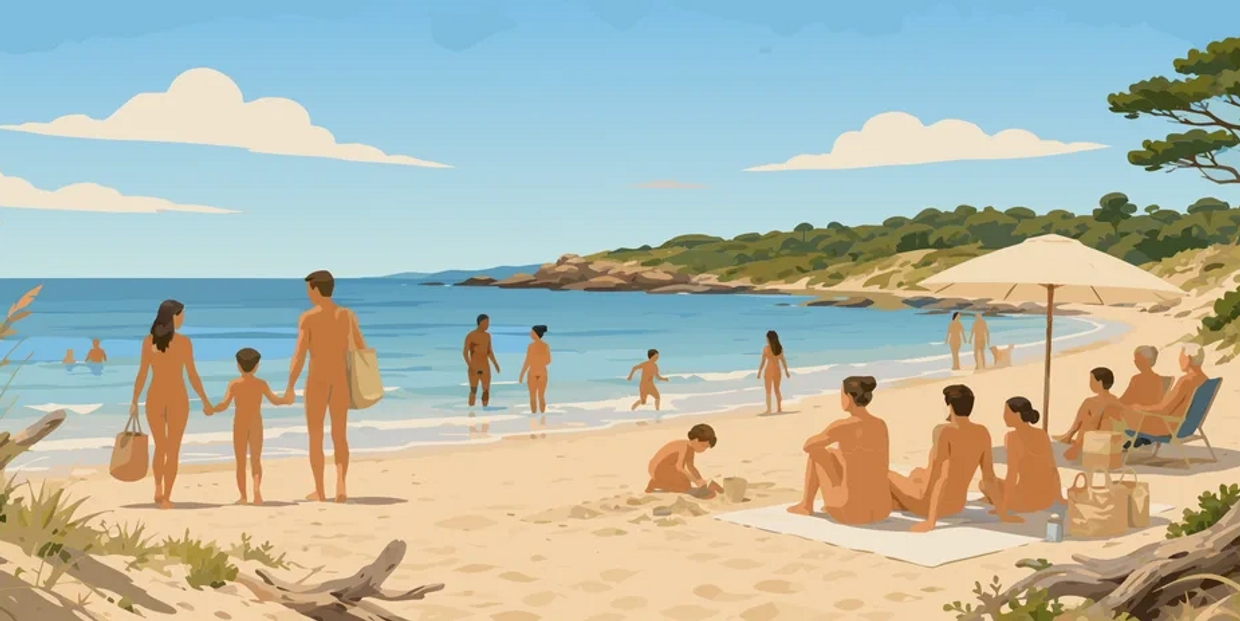
Clothing-Optional Beaches and Natural Spaces
For some people, the most appealing choice is not a club or a pool.
It is open water in natural settings.
A beach, lake, river, spring, or swimming hole can feel closer to the heart of the idea: body, water, sky, sunlight, movement, and freedom.
Clothing-optional beaches and traditional nude swimming areas can offer a less structured way to experience swimming without a swimsuit.
There may be no membership, no formal events, and no expectation that you are joining anything.
You can simply arrive, understand the local norms, respect the space, and swim.
But beaches and natural water also require caution.
- Laws vary.
- Enforcement varies.
- Local customs vary.
- Safety conditions vary.
- Crowd behavior varies.
- Some places are well-established and respectful.
- Others may be legally unclear, poorly managed, or not suitable for a first experience.
That does not mean natural water is a bad option.
It means you should choose carefully.
Look for places with a known clothing-optional history, clear information, respectful visitor culture, and practical safety.
Learn before you go.
Read recent reports when possible.
Understand parking, access, water conditions, local rules, and whether the space is appropriate for your comfort level.
A good clothing-optional beach can feel beautifully simple.
A bad or unclear one can create stress you did not need.
The point is not just to find a place to swim naked.
The point is to find a place where swimming naked feels natural and comfortable.

Hot Springs, Retreats, and Bathing Traditions
Hot springs and bathing retreats are often another good option
In some places, clothing-optional soaking is already part of the culture. The mood may be calmer, quieter, and less recreational than a beach or resort. For some people, that can feel less intimidating.
Hot springs can also connect the experience to something very basic: warmth, water, rest, and the body as it is.
But these places also vary widely.
Some are clothing-optional. Some are clothing-required. Some separate by gender. Some have specific hours or areas. Some are more wellness-oriented. Some are more social. Some are expensive or remote. Some have strict rules about towels, phones, cameras, alcohol, quiet, and behavior.
That is why the choice is not just finding a hot spring.
The choice is understanding the actual setting.
When the culture is respectful and the rules are clear, a hot spring can offer a gentle way to experience ordinary nudity without the feeling of being on display.
It can feel less like “trying a lifestyle” and more like returning to something humans have done for a very long time:
Resting in water.
Small Hosted Swim Gatherings
Between private home swims and established clubs, there is another possibility: carefully hosted small swim gatherings.
This is where Feel Good Swimming may have an important role to play over time.
A small hosted swim could be designed specifically for people who are curious, respectful, and not necessarily looking for a full nudist social world.
The emphasis would be simple:
- Clear invitation.
- Clear expectations.
- Clear consent.
- No photos without permission.
- No pressure.
- No sexual behavior.
- No body commentary.
- No surprise guests.
- No making awkwardness someone else’s problem.
Just a respectful setting where people can enjoy swimming without swimsuits.
This kind of gathering would need strong standards. It cannot be vague. It cannot rely on “everybody knows what we mean.” The clearer the boundaries, the safer and more relaxed the swim can feel.
That is especially important for beginners.
People should not have to guess what kind of situation they are entering.
They should know.
Different Choices, Different Comforts
There isn't one perfect choice.
But even in this society there are several good options.
A person may enjoy more than one setting for different reasons.
A private swim may feel safest, simplest, and most personal.
A nudist club offer a broader experience and a culture where ordinary nudity is already understood.
A clothing-optional beach may feel natural, open, and free.
A hot spring may feel calm, restorative, and connected to older bathing traditions.
A hosted swim may offer a careful middle ground: small, clear, respectful, and designed for people who just want to swim.
Each choice has its own strengths.
Each also has its own practical limits: access, cost, distance, privacy, rules, weather, safety, comfort level, and local culture.
So the question is not:
Which option is perfect?
The better question is:
Which choice feels respectful, realistic, and right for me now?
And that answer may change.
You may want privacy one day and open water another day.
You may want the structure of a club at first, then the simplicity of a beach later.
You may mostly swim at home but still enjoy resorts, hot springs, or clothing-optional water when the opportunity is right.
The point is not to find the one correct way.
The point is to make an ordinary step toward body comfort more possible.
When There Is Nowhere Yet
Some people may read all of this and still think:
I understand.
I agree.
But I still do not have a place to go.
That is real.
Not everyone has a private pool.
Not everyone lives near a clothing-optional beach.
Not everyone is near or can afford a resort.
Not everyone feels ready to visit a club.
Not everyone has trusted friends who would understand.
That does not mean this is not for you.
It means the system around swimming has made a simple human experience unnecessarily difficult.
That is worth naming.
Sometimes the first place to swim free is in your own thinking.
That is not enough forever.
But it is not nothing.
Before people change behavior, they often need permission to question what everyone else treats as obvious.
It matters when someone stops blaming themselves for hating swimsuits.
It matters when someone realizes that discomfort with swimsuits is not always body shame.
Sometimes the discomfort is telling the truth: the garment feels bad, the ritual feels strange, and the assumption behind it deserves to be questioned.
It matters when someone says:
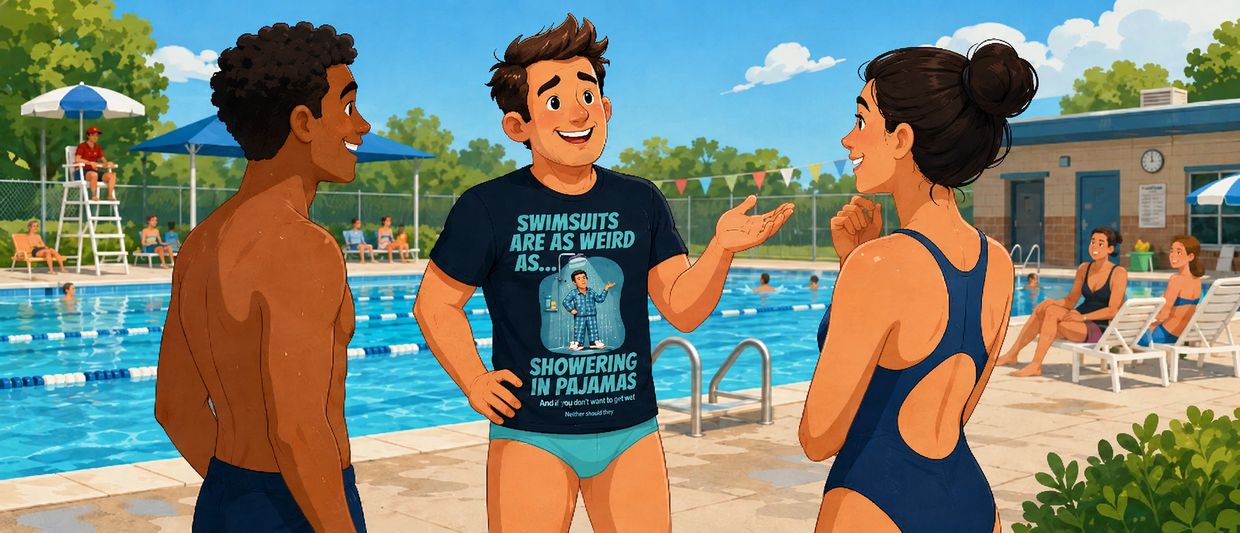
Actually, swimsuits are kind of weird.
It can also matter to make the conversation visible.
That is one reason we are designing shirts, beach towels, signs, stickers, and other items around Feel Good Swimming ideas.
Not because a product solves the problem by itself.
But because sometimes a message can open a little space before a person has to say everything out loud.
A shirt that says Swimsuits Are Weird or a towel that questions body shame can start a conversation quietly.
It can let someone else laugh, ask, agree, think, or feel less alone.
Sometimes a visible phrase does what a private thought cannot do yet:
It makes the question shareable.
It matters when someone talks honestly with a partner, friend, family member, host, club, community, or local organization.
It matters when someone supports body dignity even before they have a place to swim.
It matters when someone stops treating today’s clothing rules as if they were eternal truth.
Culture does not change only when laws change.
It also changes when ordinary people begin telling the truth in small, visible ways.
And a towel or T-shirt that says Swimsuits Are Weird can be much easier than starting with a serious conversation about body shame.
Sometimes humor gets through the gate first.
Start Where You Are
Feel Good Swimming is not here to push everyone into a label.
It is not here to tell you that you have to become a nudist.
It is not here to turn one simple curiosity into a lifestyle requirement.
It is here to help more people ask an honest question:
Does shame really belong in the water?
Maybe your first step is reading more.
Maybe it is talking with someone you trust.
Maybe it is wearing or sharing a message that helps open the conversation.
Maybe it is learning the etiquette of clothing-optional spaces.
Maybe it is visiting a reputable nudist club or naturist resort.
Maybe it is finding a legal clothing-optional beach.
Maybe it is imagining what a respectful private swim could look like.
Maybe it is simply allowing yourself to admit:
I think I might like to try this.
The point is not to act recklessly.
The point is to stop confusing today’s rules with eternal truth.
Swimsuits may be required in most places.
That does not mean they are natural, necessary, or the source of anyone’s dignity.
Sometimes the first step is finding the right place.
Sometimes the first step is simply telling the truth:
Swimming should not have become this complicated.
The body should not have become this suspicious.
Water should not feel like a test.
And a person should not have to treat the body that carries their life as a problem before they are allowed to enjoy the water.

Explore as many choices as you like
If you are curious, start with more information on the path that fits you best:
Private Home Swims
For people who want the gentlest, most controlled first step.
Nudist Clubs and Naturist Resorts
For people who want established rules, experienced communities, and legally understood places.
Clothing-Optional Beaches and Natural Water
For people drawn to open water, sunlight, and a less structured setting.
Hot Springs and Retreats
For people interested in rest, warmth, quiet, and bathing traditions.
Feel-Good Swims
A developing idea for small, respectful, clearly invited swims where the focus is simple: body dignity, consent, privacy, and enjoying the water without making it a whole lifestyle requirement.