Private swims. Clear boundaries. Less shame.
A Feel-Good Swim is a private, respectful, nonsexual swimming gathering for people who want to experience the water without swimsuit shame.
It is not about showing off.
It is not about forcing anything.
It is not about turning bodies into entertainment.
It is not about becoming a nudist, joining a movement, or adopting a lifestyle label.
It is about doing one simple, joyful thing with less shame attached to it.
Swimming is an “ing,” not an “ism.”
A Feel-Good Swim gives people a way to experience that idea in real life: ordinary people, ordinary bodies, ordinary water, clear boundaries, and enough trust for the body to stop feeling like a problem to manage.
Why Feel-Good Swims?
For many people, the hardest part of swimming is not the water.
It is the swimsuit.
The adjusting. The tugging. The squeezing. The hiding. The feeling of being judged before you even get in.
Feel-Good Swimming starts with a simple question:
What would swimming feel like if you did not have to wear your shame?
For some people, the answer may be surprisingly simple.
The water feels better.
The body feels less like an image to manage.
The mind has less to fight with.
You are just you, simply enjoying the water.
That does not mean everyone must swim without a swimsuit. It does not mean clothing is wrong. It does not mean anyone should be pressured.
It means people should have room to question the assumption that fabric equals dignity.
Dignity is not stitched into a garment.
Dignity is already present in the person.
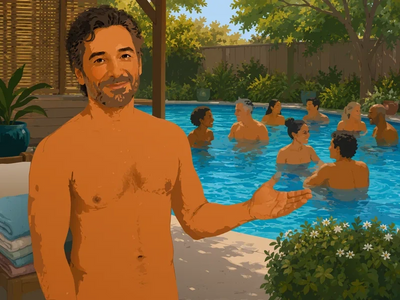
What a Feel-Good Swim is not
A Feel-Good Swim is not a sexual event.
It is not a swinger party.
It is not a dating event.
It is not a place for flirting pressure, sexual comments, cruising behavior, body inspection, photography, or exhibitionism.
It is also not a dare, a prank, or a performance.
The point is not to make bodies exciting.
The point is to let bodies become ordinary.
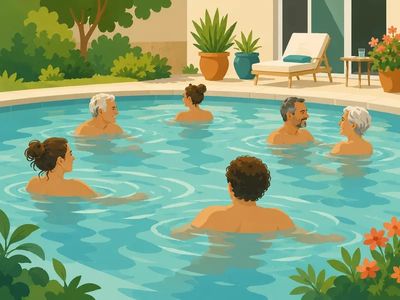
A Feel-Good Swim should feel calm, respectful, lightly social, and focused on the ordinary enjoyment of swimming. People may talk, float, splash, eat, laugh, rest, play games, or sit by the water. The body should not be the entertainment. The swim is the activity.

No pressure means no pressure
No one should be pressured to undress.
No one should be mocked for wearing something.
No one should be treated as less committed, less brave, or less “body positive” because they choose a swimsuit, towel, robe, cover-up, shirt, or shorts.
Most people have spent their whole lives being taught that swimsuits are required. A Feel-Good Swim should give people room to question that conditioning, not punish them for still feeling it.
A host may model comfort with ordinary nonsexual nudity, but the host should never demand it from guests.
The goal is not compliance.
The goal is comfort, trust, and choice.
People should be free to wear what feels right for them.
And that freedom should include the freedom to question whether they need a swimsuit at all.

Bodies are not the threat. Boundary violations are.
Feel-Good Swims are built on acceptance, not shame.
But acceptance does not mean anything goes.
Acceptance is not the absence of standards. It is the right foundation for standards.
A shame-based culture often asks, “Was a body visible?”
A Feel-Good Swim asks better questions:
- Was anyone pressured?
- Was anyone touched?
- Was anyone photographed?
- Was anyone mocked?
- Or was anyone sexualized without informed consent?
- Was anyone isolated with someone unsafe?
- Was anyone told to keep a secret?
Was anyone denied the right to leave, cover up, say no, ask a question, or tell someone what happened?
Those are the questions that protect people.
Not panic.
Not silence.
Not pretending body parts do not exist.
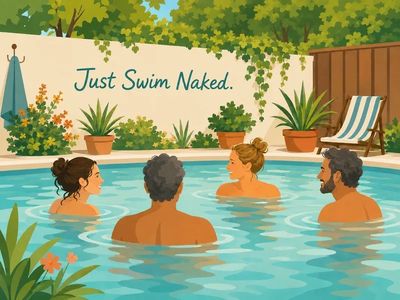
The basic standards
Every Feel-Good Swim should begin with clear standards.
These standards should be shared before the event, not explained after people arrive.
At minimum, a Feel-Good Swim should include:
- No sexual behavior.
- No sexual comments or body commentary.
- No pressure to undress.
- No photos or video without informed consent.
- No teasing, staring, mocking, or “jokes” about bodies.
- No touching without clear consent.
- No isolated adult-child situations.
- Clear privacy expectations.
- Clear arrival and departure expectations.
- A host who is willing to enforce the rules.
The rules are not there to make the swim tense.
They are there so people can relax.
Does someone need to follow all of these standards just because they have a pool and invite friends over to swim without swimsuits?
No, of course not. Private friends can make their own choices.
But a Feel-Good Swim is different. It is not just “some people swimming naked.” It is an intentional gathering built around body normality, consent, privacy, and respect. These standards help create a sense of shared trust, so people know what kind of space they are entering before they arrive.
The rules are not there to make the swim stiff or formal. They are there to protect the ease of the gathering — the feeling that everyone present understands the same purpose, the same boundaries, and the same responsibility to help others feel safe, ordinary, and respected.
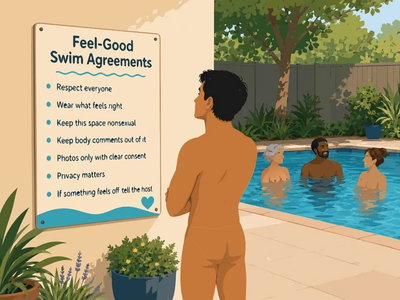
Privacy is care, not shame
Privacy matters.
Not because bodies are shameful.
Because consent matters.
A private swim area protects guests from being seen, photographed, misunderstood, or exposed to people who did not choose to participate.
Hosts should think carefully about:
- Neighbor sightlines.
- Windows.
- Fences.
- Gates.
- Upstairs views.
- Street views.
- Shared yards.
- Rental or HOA rules.
- Phones and cameras.
- Delivery interruptions.
- Drones or nearby elevated areas.
Privacy does not have to mean secrecy.
It means the people present have chosen to be present, and people outside the event are not pulled into something they did not consent to.

Keep home swims small enough to feel like community
A home-based Feel-Good Swim should stay small by design.
The goal is not to create a crowd. The goal is to create a setting where people can recognize one another, talk naturally, notice discomfort, and feel part of a shared community rather than lost in a group.
For most early home swims, about 8 to 12 people is a good target. Twelve should usually be treated as the upper limit for a private home swim, especially when children are present or when the host is still building experience.
Smaller gatherings can feel too intense if there are only a few people. But larger gatherings can quickly shift from community to crowd. Once a home event gets too large, people may feel overlooked, rules become harder to hold consistently, and the swim can lose the quiet trust that makes it work.
Home swims are not meant to imitate clubs or resorts.
Clubs can host larger gatherings because they have more space, more things to do, clearer infrastructure, established norms, and more experience.
A home swim has a different strength: intimacy, trust, and human scale.

Family and all-age swims need stronger guardrails
Home based family and all-age Feel-Good Swims should be treated with special care.
They should not be open public events.
They should not be casual mixed-age social experiments.
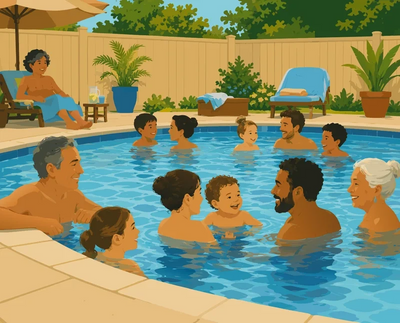
They should be parent-led, family-centered swims where each child is accompanied and supervised by their own responsible adult.
For early family or all-age home swims, attendance should be limited to family units.
That means every adult attending should be there with their own child, grandchild, or legal dependent. Adults without children present should attend adult-only swims instead.
This is not because adults without children are automatically unsafe.
It is because family swims need a clear purpose, a clear structure, and a clear boundary. They are not mixed social events. They are parent-led, family-centered swims where each child is accompanied and supervised by their own responsible adult.
Recommended family/all-age standards include:
- Only parents with their own children present may host family swims.
- Grandparents may host only when their adult children and grandchildren are present.
- No child attends without their parent or legal guardian present.
- No drop-off attendance for minors.
- No child may casually invite friends.
- No unrelated adult should be alone with a child.
- No photos of anyone without full informed consent.
- Rules must be shared with all parents or guardians before the event.
- The event should be centered on ordinary swimming, food, games, and family conversation, not body focus.
Children need protection, supervision, privacy, and adults who are held accountable.
They also need accurate language, calm answers, and a world that does not teach them their own bodies are unspeakable.
That is not less protection.
It is better protection.
Invite carefully, not widely
A Feel-Good Swim should begin with trust.
That means invitations matter.
Hosts should not blast open invitations to people they do not know. They should not post private home addresses publicly. They should not casually over-invite and hope the numbers work out.
If the target size is 8 to 12 people, the invitation list should stay close to that number.
If more people are interested, create a waitlist or plan a second swim.
A Feel-Good Swim is not meant to be exclusive in a snobby way. It is meant to be intentional.
The right people are not necessarily the boldest people.
They are the people who understand the purpose, respect the boundaries, and help make the space feel calm, ordinary, and safe.
Host resources
Feel Good Swimming is developing resources to help people think carefully before hosting.
The goal is not to make hosting complicated.
The goal is to make it thoughtful.
Possible host resources may include:
- A host checklist.
- Guest invitation wording.
- Adult-only swim guidelines.
- Family/all-age swim guidelines.
- Privacy setup guide.
- Phone and photo policy.
- Consent and behavior standards.
- What to do if someone breaks the rules.
- Sample welcome sign.
- Sample “No Photos Without Consent” sign.
- Sample “Respect Is the Dress Code” sign.
- Suggested event size and guest list planning.
- Links to privacy screens and pool-area setup tools.
- Printable or customizable invitations and signs.
A good Feel-Good Swim should feel relaxed because the important things were considered ahead of time.
What if you do not have a pool?
A home pool is not the only possible setting for a Feel-Good Swim. Some people may eventually explore private pool rentals, trusted friends’ pools, club facilities, or other private water spaces.
But the standards do not change. The host or organizer must have clear permission from the property owner, strong privacy, full consent from everyone attending, and a clear understanding of any platform, rental, legal, or local rules.
A rented pool should never be used for a clothing-optional or swimsuit-optional gathering unless the owner has clearly agreed to that use in advance.
Let Swimming Be Swimming
One Simple Thing, Fully Enjoyed
Home-based Feel-Good Swims are not meant to replace nude beaches, naturist clubs, resorts, or organizations.
They are also not meant to be merely a stepping stone to those places.
A small private swim can be complete in itself.
Some people may never go to a nudist club, resort, or nude beach. That is fine. Swimming is swimming. For someone who simply wants to enjoy the water without the discomfort, pressure, or symbolism of a swimsuit, a small private swim may be exactly enough.
But “enough” does not mean “better than everything else.”
Clubs, resorts, and established clothing-optional beaches can offer things a backyard pool usually cannot. Some have larger pools, sports courts and activities, camping, meals, dances, events, long-term community, and sometimes even places to live. Some also have acreage, trails, trees, lakes, gardens, open land, or access to the beach — places where body normality can feel connected to nature, not only to swimming.
That can be wonderful for people who want that larger social world or deeper reconnection with sun, wind, water, trees, and open space.
But not everyone who wants the water without the swimsuit is looking for a lifestyle.
Others may start with a private swim, enjoy it deeply, and later feel comfortable visiting a club, resort, organized event, or clothing-optional beach. That can be a good next step for some people.
But it is not the point everyone has to move toward.
Home swims do not have to compete with nudist clubs. They can simply help more people discover whether body normality is something they want more of — in the water, and maybe beyond it.
A private swim may help someone realize:
- This is not strange.
- This is not shameful.
- This is not about sex.
- This is just swimming.
- It is freedom.
And for some people, that may be enough.
Freedom starts close to home
Feel-Good Swimming is not trying to pressure anyone into anything.
It is trying to make room for a question most people were never invited to ask:
What would swimming feel like if my body did not have to be treated as a problem first?
For some people, the answer may begin in a backyard pool.
For others, it may begin at a club, a beach, a trusted friend’s home, or simply in the imagination.
The setting matters.
The standards matter.
The people matter.
But the deeper idea is simple:
Bodies are ordinary.
Consent is essential.
Shame is not safety.

And swimming should feel good!