Why Swimsuits Are Weird!
The strange normal thing we almost never question
Swimsuits feel normal because most of us were trained not to question them.
You go swimming, so you put on a swimsuit. That is the rule. It feels so ordinary that it can seem ridiculous to call it strange.
But step back for a moment.
Swimming is one of the most body-direct activities a human being can do. You are entering water. Your body is moving, floating, cooling, playing, resting, and breathing. The water touches the whole body evenly. Nothing about the experience naturally requires a specialized garment.
And yet modern culture has turned this simple pleasure into a small ritual of body management.
Before you enter the water, you are expected to choose a garment that covers some parts, reveals other parts, fits the current fashion standard, flatters the “right” areas, hides the “wrong” areas, dries quickly, does not ride up, does not slip down, does not cling too strangely, does not expose too much, does not look too old-fashioned, does not look too childish, does not look too sexual, does not look too plain, and somehow makes you feel comfortable while being judged by all of that at once.
That is weird.
Not evil. Not always harmful. Not something everyone must reject.
Just weird.
And once we can say that honestly, the whole conversation about swimming, bodies, modesty, shame, and comfort starts to open up.

The body was never the strange part
A human body in water is not strange.
Every person has a body. Every body has skin. Every body has weight, shape, age, asymmetry, scars, softness, hair, marks, folds, bones, and movement. Everyone has genitals, yep them too. Very common. These are not design flaws. They are what bodies are.
The strange part is not the body.
The strange part is the cultural machinery wrapped around the body.
Swimsuits do not simply “cover” the body. They train us to see the body in divided zones: acceptable, unacceptable, revealable, concealable, flattering, embarrassing, presentable, inappropriate.
That division changes the way people experience themselves.
Instead of entering the water as a whole person, many people enter the water as an image to manage.
- Is this too tight?
- Is this too loose?
- Is this too revealing?
- Is this flattering?
- Does my body look wrong?
- Am I allowed to enjoy this yet?
That is a heavy load to carry into something as light as water.
For the deeper foundation behind this argument, read: “The Body Parts We Refuse to Normalize.”

Swimsuits are treated as modest — but they also organize attention
One of the strangest things about swimsuits is that they are treated as the modest solution.
But modesty is not as simple as “more fabric equals less attention.”
A swimsuit covers selected parts of the body. But that selective covering can make those parts more charged, not less. Once the body is treated as something that must be selectively hidden, the covered areas become culturally loaded. The swimsuit does not remove sexual attention from the body. It often organizes it.
Nudity presents the body as a whole.
Swimwear divides the body into parts: what must be hidden, what may be shown, what should be shaped, what should be lifted, what should be minimized, what should be displayed, and what will be judged.
That division is where much of the charge begins.
This does not mean people who wear swimsuits are trying to be sexual. Most people wear swimsuits because that is the only socially permitted choice. The point is not the wearer’s intent. The point is the garment’s cultural effect.
A swimsuit can be socially required as “modest” while still making the body more visually framed, inspected, and sexualized than ordinary non-sexual nudity.
That is part of why swimsuits are weird.

The swimsuit is not just clothing. It is permission.
In many places, a swimsuit functions less like clothing and more like a ticket.
It says: now you may enter the water.
That may sound normal because we are used to it. But it is worth questioning.
Why should one cultural garment become the price of admission to one of life’s simplest pleasures?
The problem is not that swimsuits exist. The problem is that swimming has been culturally organized around the assumption that the body underneath the swimsuit is unacceptable by default.
That assumption is rarely spoken directly. It does not need to be. It lives in the rule.
Before the body touches the water, it must be packaged.
Before the person gets to feel free, the person must first be made presentable.
That is not a natural law. It is a cultural arrangement.
And cultural arrangements can be examined.

Swimsuit history shows how unstable “normal” really is
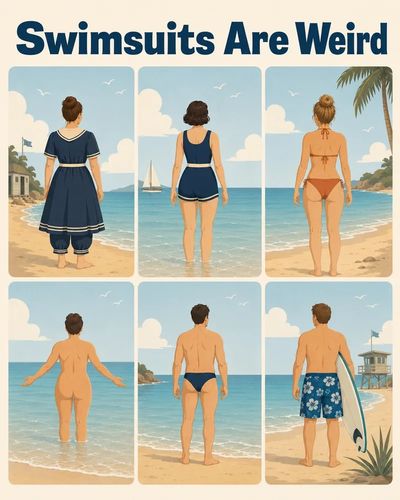
What people consider proper swimming attire has changed dramatically over time.
In the nineteenth and early twentieth centuries, women’s bathing clothes could be heavy, bulky, and restrictive. The Smithsonian notes that voluminous bathing dresses were standard beachwear from the 1860s, and that women did not begin abandoning heavy “bath flannels” for more streamlined one-piece suits until the 1920s. [1]
Women’s swimwear has often moved from heavy public modesty toward smaller, more revealing garments. Men’s swimwear followed a stranger path. In many places, men once swam naked as a normal practice. Then, as swimming became more public, regulated, and mixed-gender, men were pushed into suits — sometimes even suits with tops.
Then came the twist: after men won the freedom to swim bare-chested, men’s suits did not simply keep shrinking. They often grew larger, longer, and bulkier.
Women’s suits often shrank. Men’s suits often expanded.
Swimsuits are weird.
The Fashion Institute of Technology’s fashion history project describes women’s swimwear as a garment that has reflected changing social and technological forces over time. [2]
That matters because it reminds us that “normal” swimwear is not fixed. It changes with culture, technology, gender rules, class expectations, manufacturing, fashion, and public morality.
What looks normal now would have scandalized people in another era.
What looked proper then may look absurd now.
And what feels unthinkable now may feel ordinary in another context.
Human body norms change. What a culture calls “decent,” “normal,” “respectable,” or “shameful” is not fixed in the body itself. It is built around the body.
Respectability has always been part of the swimsuit story
Swimwear was never only about comfort in water.
It was also about public respectability.
As public bathing became more regulated, bathing clothing became part of respectability. And respectability has always been class-coded. What the wealthy could buy, the poor could be judged for lacking.
A person needed the proper garment, the proper coverage, the proper look, and the proper relationship to public space.
This is one reason the history matters. Swimsuits were not simply invented because bodies needed fabric in order to swim. They developed within social systems that were deeply concerned with gender, class, morality, public order, and who was allowed to appear respectable.
The body did not create those anxieties.
Culture did.

There have always been other ways to experience swimming
It is easy to assume that swimsuits are universal, timeless, and inevitable.
They are not.
There have been many times and places where people swam without specialized swimwear. Even in modern history, nude swimming was once common or required in some male-only indoor swimming settings, including YMCA and school contexts. WHYY reported in 2025 on the history of boys being required to swim nude at YMCA pools, a practice that now sounds unbelievable to many people precisely because body norms changed. [3]
This does not mean every old practice was good, equal, or worth reviving exactly as it existed. Many past customs were shaped by sexism, segregation, exclusion, and unequal rules. The move to unsegregated swimming was good, the move to suits was not.
But it does prove something important:
The belief that swimming must require a swimsuit is not a timeless human truth.
It is a cultural habit.

“But I would feel more self-conscious naked, not less.”
That reaction is completely understandable.
Most people have lived inside swimsuit culture their entire lives. If you have spent decades being taught that your body must be covered, corrected, packaged, and approved before it enters public water, then the idea of swimming without that covering may sound terrifying.
Thinking about it can feel more self-conscious, not less.
But thinking is not the same as experiencing.
Self-consciousness often grows in imagination. The mind rehearses every fear. It pictures being looked at, judged, compared, exposed, or embarrassed.
But in a calm, respectful, non-sexual setting where ordinary people are treating ordinary bodies as ordinary, the mind often has less to fight with. The body stops being an image to manage and becomes something simpler again.
You are just you, simply enjoying the water.
That does not mean everyone will feel comfortable instantly. It does not mean anyone should be pressured. It does not mean naked swimming is right for every person, every place, or every situation.
It means the fear people imagine is not always the experience people have.
Often, the body is most frightening when it is still trapped in the story.

Feel Good Swimming is not anti-swimsuit.
This point matters.
Feel Good Swimming is not about shaming swimsuits.
It is not about telling people they are wrong for wearing one.
It is not about pressure.
It is not about showing off.
It is not about turning bodies into entertainment.
It is not about making anyone uncomfortable.
A swimsuit can be useful. It can be practical. It can be required by law, setting, family comfort, personal preference, weather, sun protection, or simple habit. Some people genuinely feel better wearing one. That is their choice.
The issue is not whether swimsuits should exist.
The issue is whether swimsuits should be treated as proof that the body underneath is unacceptable.
There is a huge difference.

Swimming is an “ing,” not an “ism”
One reason this conversation gets tangled is that people often turn simple actions into identities.
Feel Good Swimming is not asking everyone to become a nudist, naturist, activist, or lifestyle convert.
Swimming is an “ing,” not an “ism.”
The point is not to adopt a label.
The point is to ask a simpler question:
What would swimming feel like if I did not have to wear my shame?
That question is the doorway.
Not pressure. Not ideology. Not performance.
Just curiosity.
What if the problem was never your body?
What if the discomfort came from the rules wrapped around it?
What if swimming could become simple again?

The world’s best swimsuit may not be a swimsuit
There is a playful truth hiding here.
The world’s best swimsuit may be no swimsuit at all.
Nothing to adjust.
Nothing to prove.
Nothing digging into the skin.
Nothing clinging in the wrong place.
Nothing dividing the body into zones of approval and embarrassment.
Just water.
Just movement.
Just breath.
Just you.
That does not have to be shocking. It can be ordinary. It can be quiet. It can be respectful. It can be non-sexual. It can be as simple as a body in water, no longer treated as a problem to solve.
Maybe the body was never the problem.
Maybe the problem was the cultural machinery wrapped around the body.
And maybe swimming could feel easier if we stopped treating the human body as something that must be corrected, packaged, disguised, and approved before it enters the water.
References
[1] Smithsonian National Museum of American History, “When did bathing become swimming?”
[2] Fashion Institute of Technology, Fashion History Timeline, “A History of Women’s Swimwear.”
[3] WHYY, “Remember when nude swimming was required?”
[4] Smithsonian Magazine, “How Swimsuits Became Fashion Items.”