The Shift
To dismantle a deeply rooted mass delusion, we have to look past our fears and examine our history. A century ago, our culture arrived at a major crossroads regarding the human body. Two different groups faced the exact same suffocating, puritanical rules in the public realm. The choices they made—and the long-term results of those choices—provide the exact blueprint for how we reclaim our sanity today.
A Tale of Two Strategies
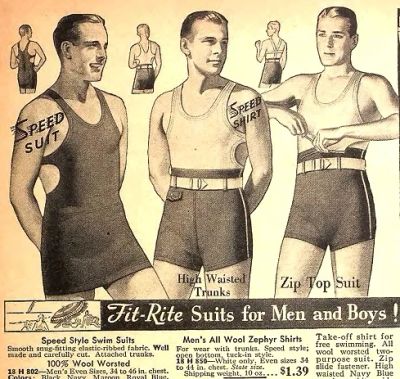
In the early 1930s, it was an arrestable, scandalous offense for a man to show his bare chest at a public beach. To fight this rule, a group of ordinary citizens launched the movement for men’s top freedom. They didn't beg for secluded, gated clubs, and they didn't hide in remote valleys. Instead, they used a direct public strategy: ordinary men simply refused to wear shirts at public shores. They showed up frequently, caught citations, filled the local courtrooms, and forced the public to look at normal, boring chests until the rule makers finally gave up out of sheer exhaustion. Today, a man swimming shirtless is so completely common and ordinary that nobody even notices it. The taboo was entirely erased because it was fought out in the open.
At the exact same time, the traditional nudist and naturist movements were forming. Instead of fighting the public mandate, they chose a defensive retreat. They built high fences, retreated into secluded camps, and begged the system for isolation, promising to stay completely out of sight.
The long-term results speak for themselves. By hiding, the old movement accidentally validated the lie—confirming the idea that the normal human body is a scandalous, volatile emergency that decent people shouldn't have to look at. A century later, they are still trapped behind those walls, highly vulnerable to modern digital threats, while the public square remains entirely dominated by engineered shame. If the men of the 1930s had chosen the secluded club route, men would still be paying a membership fee to take their shirts off behind a ten-foot fence today. Normalization happens through public frequency, not defensive isolation.
The Tactical Laboratory of the Water
We are entirely finished playing defense, and we are not pleading for tolerance. We are picking up the exact public, frequent blueprint that already won. Our primary proof of concept is the simple, common-sense act of swimming, because water and clothing don't mix.
We pull the rug out from under the moral panic by sticking strictly to the pure physics of comfort. A swimsuit in the water creates drag, retains cold moisture, traps debris, and restricts natural breathing. By focusing entirely on ergonomics and utility, we remove the heavy, sexualized lens that culture forces onto our skin.
Think of the unbothered, absolute delight of a toddler splashing at a backyard sprinkler. Before we are taught to compare, hide, or apologize, our first instinct is simply to feel the water and join the fun. That natural capacity for pure, uncomplicated joy doesn’t vanish when we grow older; it just gets crowded out by a lifetime of learned anxiety. The body is not a costume for shame or a public performance. Water invites the body to feel simple again, and we are using the water as our laboratory to remember that our worth is a factual reality, not a prize to be earned through commercial compliance.
Defying the Digital Fakes
In an exhausting era of ubiquitous smartphones, deep fakes, and artificial intelligence, playing along with the defensive script of hiding has become our greatest security risk. When we rely on a fragile piece of synthetic fabric to protect our dignity, we hand total leverage to the online bully and the camera. We have to face the real world we live in now with open-ended, common-sense questions:
If we continue to treat our natural skin as a dangerous, hidden treasure, aren't we actively manufacturing the exact taboo that blackmailers and exploiters use as economic fuel?
How can a digital deep fake contaminate our public memories or threaten an individual who has already chosen to stand unburdened in the public square, refusing to hide?
And if a non-consensual photo is captured, what does it actually show if natural skin is already treated as completely common and ordinary?
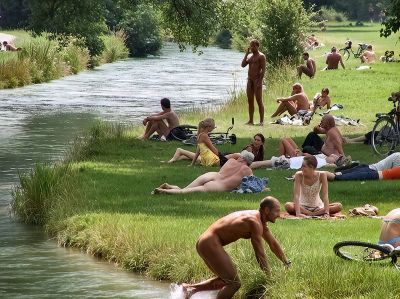
You cannot deep fake a person who refuses to hide. When we make our presence frequent and unremarkable in public spaces, we completely crash the market value of the non-consensual photo. They want a high-voltage scandal to monetize, but we give them a calm, unbothered neighbor who is simply enjoying the sunshine and the water.
Normalization is the only tactical shield that works in a digital world. We don't need higher walls; we need to tear the walls down.

The Action Strategy: Feel Good Swims
Our goal is to make natural skin a common, boring, everyday reality, we hope to direct some of the protest energy of events like the World Naked Bike Ride from the pavement into the water. But we are completely ditching the once-a-year "carnival novelty" trap. The biggest weakness of a yearly event is that it becomes a spectacle, attracting spectators who just want to leer or treat it like a parade.
We also realize the need for massive numbers to achieve such a shift, a handful of people on a beach of thousands, will not work. Our plan is to start with community building, gathering support and commitments, and then launching public Feel Good Swims, with a massive coordinated event, followed by regular events.
If we swim weekly or even daily, the shock value completely evaporates. It stops being a stunt and becomes an ordinary, neighborly presence.
Regularity completely defangs the online bully and the casual voyeur. Nobody can maintain a hostile, hyper-sexualized stance against something that is happening quietly and consistently every everyday. The water offers an immediate, physical boundary—it covers us, holds us, and welcomes us exactly as we are. We aren't blocking traffic to prove a point; we are actively practicing the liberation we are talking about.
We are taking the public square back by making the natural body beautifully boring. Regularity completely defangs the online bully and the casual voyeur. Nobody can maintain a hostile, hyper-sexualized stance against something that is happening quietly and consistently every day. The water offers an immediate, physical boundary—it covers us, holds us, and welcomes us exactly as we are. We aren't blocking traffic to prove a point; we are actively practicing the liberation we are talking about.
We are taking the public square back by making the natural body beautifully boring. We are shedding the layers of artificial shame, reclaiming our human dignity, and refusing to participate in a collective lie any longer. The sun is hitting the truth. The body is decent as it is.
But a shift this massive cannot be built on individual, isolated actions. We need numbers, coordination, and a shared playbook.

Step Onto the Offensive Line
We are entirely finished playing defense, and the work starts right here in our neighborhoods. Here is how we turn this philosophy into a practical capability today:
- Download the Action Guide: Grab our free PDF playbook, Reclaiming the Water. This guide breaks down the exact logistics, the legal baselines of public expression, and the practical steps for organizing a frequent local swim without getting trapped in the carnival spectacle.
- Join the Ranks: We are actively gathering support, commitments, and local leaders to build the foundation for our first massive, coordinated launch event. Sign up for our community newsletter to connect with your neighbors, coordinate local meets, and pledge your presence.
Let's look the system error in the eye, step out of the isolation trap, and change the world on our own terms. Stand up, join the movement, and shed the lie.