The Swimsuit and the Divided Body
Toward a Whole Body Ethic
More parts of the human form are visible at a pool or a beach than in almost any other everyday social setting. We see arms, shoulders, backs, bellies, thighs, and feet. We see skin, scars, wrinkles, weight, and hair. Yet, a few inches of fabric routinely determine whether a person is a "normal swimmer" or an "unacceptable body."
The problem is not that swimsuits exist. A swimsuit can be a beautiful personal choice—a practical tool for comfort, protection, style, or privacy. The problem arises when one specific garment becomes the mandatory price of admission to one of life’s simplest physical pleasures.
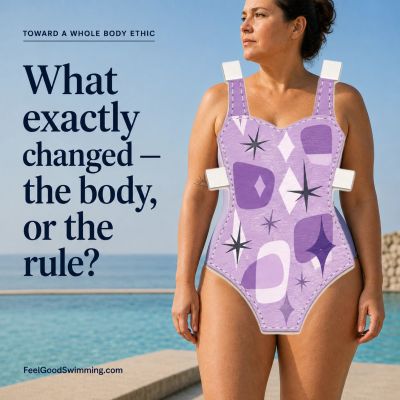
When fabric becomes a permit to belong, it treats the human body like a paper doll. It flattens a living, breathing creature into a cardboard cutout, slapping a temporary social license on top of a real person. We fold down the paper tabs at the shoulders and hips, hoping our temporary uniform makes us acceptable enough to join the world. This paper-doll logic subtly trains us to see ourselves in fragmented zones: this part is acceptable, but that part is forbidden; this much skin is normal, but that much skin is a problem.
But water never divides the body. Water doesn't map out zones of dignity and zones of danger. Water simply meets skin directly. The human rules and the accompanying anxieties come later.
The Training of the Eye
Most of our clothes serve obvious, practical functions. A heavy coat protects against the winter chill. Sturdy shoes protect our feet from rough pavement. Everyday clothing allows us to express our personality, culture, and taste. At the water’s edge, however, those practical functions shift. In the water, extra fabric becomes heavy. It drags, clings, holds moisture, and restricts our natural range of movement. It creates physical friction in the exact environment where the human form is naturally suited to move with weightless ease.
Yet we treat the outline of the swimsuit as an absolute social requirement. We have trained our eyes to accept the body only as an abstract piece of marble, while treating living, breathing skin as an immediate emergency.
Consider the bizarre cultural moment in Florida when a school principal was forced out of her job simply because sixth-grade art students were shown an image of Michelangelo’s David. After five centuries of being celebrated as a pinnacle of human dignity, a parent labeled the masterwork "pornographic." We live in a world where our nervous systems have been so deeply conditioned that we look at a historical statue and instinctively panic because nobody slapped a pair of swim trunks on it. We treat natural anatomy as a scandal waiting to be covered up.
Over time, this training becomes so quiet and familiar that it starts to feel completely natural. A child does not arrive in the world believing that their belly, hips, or skin are inherently shameful regions that require a fabric permit to enter a pool. That lesson is gradually taught through subtle rules, nervous glances, jokes, and the sudden seriousness adults bring to some parts of the body and not others. Eventually, we learn the map. We learn which parts of ourselves can be ordinary, and which parts must be constantly supervised.

The Burden of Self-Surveillance
This learned map is the real source of our deep self-consciousness at the pool. Because the swimsuit creates an arbitrary border, we spend our energy managing the outline. Almost everyone has experienced the quiet, exhausting work of self-surveillance: tugging at fabric, adjusting straps, checking waistbands, smoothing edges, and pulling down hems. We shift towels, angle our torsos, avoid certain movements, and worry about whether our skin is behaving appropriately.
Often, this tension is small and nearly invisible. It is the instinctive adjustment we make before standing up from a lounge chair, the towel held tightly across the front, or the quick downward glance to ensure everything is hidden. It is a person trying to enjoy the cool relief of the water while simultaneously acting as their own strict security guard.
A monitored body is never fully at ease. When we divide the body into acceptable and unacceptable zones, swimming stops being an experience and becomes a project. We find ourselves constantly checking the suit, checking the towel, checking the angle, and checking the rule. That is a heavy form of mental labor. We may be used to it, but being "used to it" is not the same thing as being comfortable. A pebble in your shoe can become familiar, but that doesn't mean the pebble belongs there.

Is the Body Inherently a Spectacle?
When we talk about dropping these defensive barriers, a common objection arises: Isn't the human body inherently sexual?
The honest answer is: sometimes, but context is everything. The body can be sexual in intimate contexts where mutual desire and boundaries are explicitly shared. But the body is also functional, medical, athletic, playful, and ordinary. It is a living creature that ages, heals, gets tired, rests, and breathes.
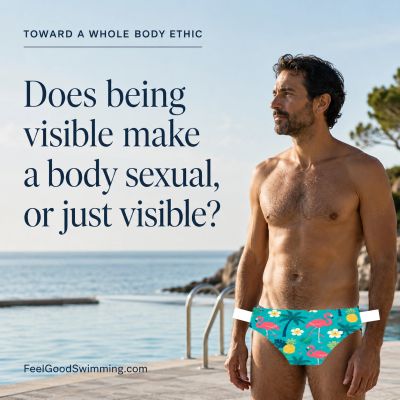
A body moving through water is not a sexual invitation. A body drying off in the sun is not a public performance. A body experiencing gravity-free relaxation is not automatically asking to be judged, rated, desired, or controlled. One of the greatest failures of modern lifestyle culture is that it flattens the human form into a pure spectacle. It teaches us to treat visibility as availability. But being visible does not mean being public property. Being uncovered does not mean consenting to someone else’s interpretation or critique. Reclaiming a whole-body approach doesn't deny our sexuality; it simply puts it back into its proper context. It asserts that you are still a whole person, even when your skin is meeting the water.
Privacy, Consent, and Care
Stepping away from body worry does not mean boundaries no longer matter. True body comfort requires more respect for personal boundaries, not less. Privacy and consent matter deeply, especially in a digital age dominated by cameras and smartphones. No one should be photographed, recorded, or turned into online content without their explicit permission. The human form is not shameful, but the human person always has an absolute right to control their own visibility.
These twin truths do not contradict each other; they protect each other. Privacy is not proof of shame; it is an act of care. Consent is not necessary because the body is dirty; consent is necessary because the human being inhabiting that body is real. Many people are not actually uncomfortable with the natural world or the water; they are afraid of being captured. They are afraid of losing control of their own image, or that a careless person with a phone will turn an ordinary, vulnerable human moment into permanent public exposure. A healthy community must hold both realities together: we celebrate the natural dignity of the ordinary human form, and we fiercely protect the safety, privacy, and boundaries of every individual who joins us.

From Division to Wholeness
The habit of dividing the body doesn't stay at the pool. Once we learn to sort skin into approved and unapproved zones, that same judgment shapes how we experience every other aspect of human life. It alters how we view aging, weight, physical limitations, illness, and scars. We begin to sort people before we ever get to know them. Younger, highly polished bodies are treated as socially welcome, while ordinary, soft, changing, or older bodies are hidden, ignored, or treated as public problems to be corrected.
The real test of body comfort is not just how we look at ourselves in the mirror. It is how we allow other people to exist around us, and—just as importantly—how we allow ourselves to exist around them. It is the freedom to sit, move, breathe, and speak in a shared space without carrying the exhausting mental weight of an ongoing defense case.
Modern psychological research actually confirms what our instincts already know. When researchers studied people who step away from the paper-doll standard and spend time in spaces where ordinary, unpolished bodies are allowed to simply exist, the ambient anxiety disappears. Interestingly, the biggest relief doesn't come from being seen—it comes from seeing. By looking at a pool or a beach full of real, non-idealized, everyday human beings, our brains quietly reset. We unlearn the artificial blueprint of perfection, drop our standard defense mechanisms, and realize that we are finally safe to exist exactly as we are.

Water Without Inspection
Feel Good Swimming is simply a practical space where we try out a better default. We aren't here to preach a complex philosophy, demand a radical lifestyle shift, or turn your recreation into a political debate. We are just asking a simple question: What if swimming didn't have to begin with body division? We design environments where you don't have to pass through a visual approval system just to enjoy the water. This isn't about forcing one rigid answer on everyone, nor is it about being careless with the personal backgrounds, traumas, religious needs, or sensory boundaries of others. It is about building a community where ordinary bodies are allowed to be ordinary, and water is allowed to be water.
People move differently when they aren't constantly bracing for judgment. They relate to one another with greater warmth when they aren't exhausting themselves with self-surveillance or hiding from those around them. When you step into the pool with us, the paper-doll outline fades away, and the simple, weightless joy of being alive takes its place. The swimsuit, the camera, and the cultural rules can try to divide us into parts. But you are a whole human being. Your dignity is whole. And swimming should feel like joy, not body management.
FeelGoodSwimming.com