The Effect: The Deep Roots of Manufactured Insecurity

The mandatory rule to wear synthetic clothing in every single public space is a deeply established, everyday custom. But it is a profoundly unhealthy one. It acts as a systemic tool used to divide, control, and wear us down, leaving ordinary people completely exposed to a stressful whirlwind. To understand how to find a path forward, we have to look past what is considered "normal" and look instead at whether this custom is actually beneficial or healthy for our lives and our relationships with our neighbors.
We are completely exhausted. Every single day, we navigate a modern digital pressure cooker that demands our absolute, unflinching compliance with an artificial standard of perfection. We scroll through feeds filled with airbrushed digital cutouts, pristine fashion templates, and heavily curated Hollywood molds, only to look down at our own shapes and feel a gnawing sense of failure.
From the day we are born, a massive, commercialized cultural machine whispers a lie into our ears: that our human worth is tied directly to how closely we match a specific, manufactured physical ideal. This conditioning runs so deep that it shapes everything. We see it in our careers, our social environments, and our daily interactions. Society routinely hands those deemed "traditionally attractive" better opportunities, higher earning potential, and automatic social trust. It is an arbitrary, systemic hierarchy that functions exactly like a psychological caste system. A superficial physical trait, entirely determined by a genetic lottery, is weaponized by culture to decide who belongs in the light and who should remain hidden in the dark.

The Elephant in the Room: The Temptation Taboo
At the absolute center of this whole setup sits the ultimate elephant in the room: the hyper-sexualization of the normal human body and the manufacturing of the temptation taboo.
The unspoken assumption our culture lives by is that a bare human body is a dangerous, explosive signal that regular people are simply incapable of handling. Instead of teaching people the practical capability of managing their own minds, desires, and respect for others, those in charge took a lazy shortcut: they covered the target. They told us fabric had to act as a firewall to keep us behaving.
But that shortcut backfires every single day. By banishing natural skin completely from ordinary public life, the rule took something completely common and turned it into an artificial mystery. It made the body look sexual simply by turning it into a dirty secret.
Because our culture insists that bare skin can only mean one thing, we are robbed of the simple ability to just exist. When we want to go for a swim, we aren't trying to show off or send some provocative message; we are just trying to touch the water the way we are meant to touch the water. But the rule forces a heavy, sexualized lens onto a basic, healthy activity. The shock isn't human nature; it's the conditioning.

Turning Neighbors Against Neighbors
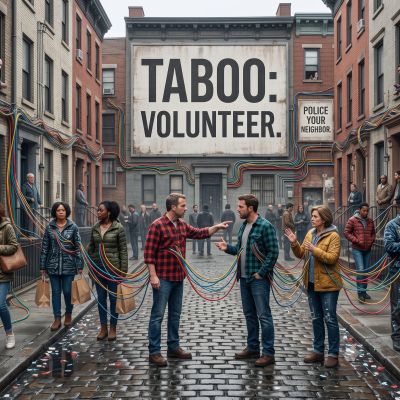
The saddest part of this engineered taboo is that it successfully turns us against each other. Instead of looking at how our world is set up to cause modern burnout, stress, and isolation, the shame taboo makes us look sideways.
Ordinary people end up volunteering to be the unpaid morality police for their neighbors. We judge, criticize, and watch each other to make sure everyone is wearing the proper synthetic uniform. The people at the top win because as long as we are busy arguing about swimsuit lines on a beach or pool deck, we are too distracted and divided to ever join hands and demand a better life.
The Tool vs. The Mandate: The Illusion of the Armor
Let's be completely clear: Clothing is a wonderful, highly functional human invention. It keeps us warm and dry in bad weather. It gives us a beautiful way to express our creativity, our culture, and who we are. On a practical level in our towns, it lets us know what's happening in an instant—we can spot the firefighter, the police officer, or the security guard when someone needs help.
The damage doesn't come from the existence of clothes. It comes from the extreme, unyielding rule that forces fabric into places where it makes absolutely no sense, actively harming our health, psyche, and well-being.
To protect ourselves from ruthless social judgment, we buy into the armor. We put on the clothes, hoping the fabric will act as a correction, an equalizer, or a shield. And let’s be entirely honest: the armor does something. Fabric is engineered to create symmetry, mask the soft edges, and hide the natural wear-and-tear of a life fully lived. Most of us are not runway models. Most of us are not perfect tens.
But the simple reality is that the armor ultimately fails us.
Even fully dressed, the gnawing feeling of self-awareness doesn't vanish. We still feel the friction. We still worry if the fabric is hiding enough, smoothing enough, or keeping up with the illusion well enough. Clothing doesn't actually cure our anxiety; it just acts as a mandatory concealment system that keeps us trapped in a cycle of constant self-policing.
When an extreme rule forces a human being to strap annoying, wet layers of plastic onto their skin just to touch public water, the tool has been turned into a mandatory mask. By forcing a total monopoly of clothing across every single inch of public life, the system ensures we can never interact with another human being at a true human level without a corporate filter between us. It forces us to look at each other through status and shame, rather than letting us just live together as unburdened peers and neighbors. We’ve been brainwashed into believing we have to look a certain way just to earn the right to step out into the sun and enjoy our lives.
We have confused a tailored illusion with our actual human worth. But human dignity is an observable fact, not a prize to be won in a genetic lottery.
The Deep Roots of Control: Religion, Politics, and Class
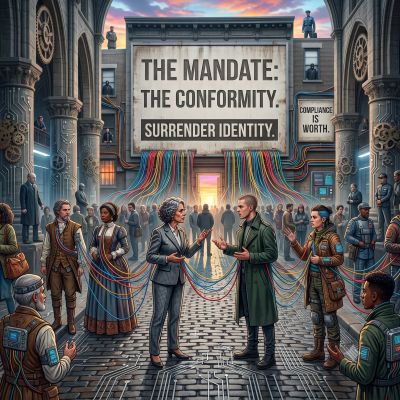
Body anxiety is not a new marketing trick. For centuries, religious institutions, political power structures, and dominant class systems have used the mandatory clothing rule to keep us in check.
By training us to look at our own natural skin—the very place where our life, breath, and awareness happen—as a permanent moral emergency, those in power get us to focus all our attention inward. They keep us insecure, self-critical, and easy to manage.
Historically, clothes were used to draw hard lines between the rich and the poor—dictating who has the money to hide away, who is forced to sweat, and who gets to decide what is "decent." By keeping an internal war going inside every single individual, the system ensures that ordinary people are too exhausted by their own worry to ever look up and challenge the setups that are running our world.
The Science of Dropping the Armor
For decades, critics and skeptics of body openness dismissed the idea of social nudity by inventing a myth. They claimed a classic case of selection bias: “Of course those people are comfortable,” they argued,*“only people who already have perfect bodies choose to take their clothes off.”
It is a completely upside-down assumption. In reality, flawless, "perfect ten" bodies do not populate nudist environments. Walk into any real space where people drop the armor, and you will see that the vast majority are completely normal, average, everyday neighbors.
Yet, because the outside world couldn't see past its own conditioning, they assumed a selection bias existed. That cynical assumption was completely shattered by the landmark empirical research of Dr. Keon West.
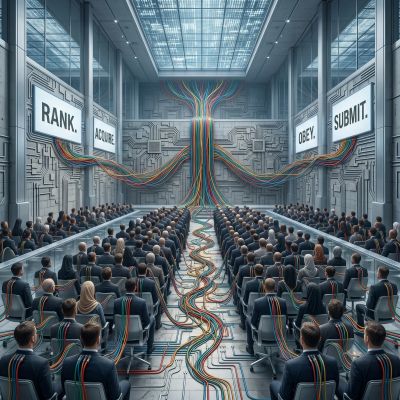
Conducting the first-ever Randomized Controlled Trials (RCT) on social nudity, Dr. West did something unprecedented. He didn't study lifelong naturists. Instead, he took ordinary, non-naturist participants who carried the exact same body anxieties as the rest of our culture and randomly split them into groups. Some remained clothed; others entered communal, unclad spaces.
The data that came back was undeniable. Communal nakedness didn't just correlate with confidence—it *caused* it. Even brief, casual exposure to spaces where people dropped their clothes triggered a massive, measurable spike in overall life satisfaction, a surge in self-esteem, and a dramatic plunge in body dissatisfaction.
But the most profound discovery was the exact psychological mechanism behind this shift. Dr. West tested multiple theories to see why the human brain healed so quickly in these spaces. The data proved that being naked with others didn't change how attractive people thought others were. Instead, it worked by completely decimating Social Physique Anxiety (SPA).
When you are trapped in the clothed world, your brain is starved of reality. It only sees the airbrushed perfection of media or the structured camouflage of fashion. But when you enter a space where ordinary neighbors drop the armor, the brain experiences an immediate reality check.
You see a room full of real, diverse, un-airbrushed human skin—asymmetry, soft edges, scars, and all. And in an instant, the deep-seated fear of being negatively judged by others melts away. You realize that everyone is carrying a completely unique, imperfect, and entirely normal human form. Once that Social Physique Anxiety is slashed, a realistic, lasting appreciation for your own body naturally rushes in to take its place. Look at any community that has successfully dropped the armor by default. You don't see preening, modeling, or people showing off. What you actually observe is a profound, quiet relief. Our brains instantly start unlearning the lie.

The Trap of Secrecy and Why Hiding Failed
For generations, we were taught that covering up was our shield, and our way of staying safe. But in the modern digital world, that old training has become a major trap.
Today, hiding behind a piece of cloth is actually the greatest risk we take.
When you rely on a fragile scrap of mandated fabric that you’ve been conditioned to believe will protect your dignity, you hand all the power over to the camera and the crowd. The swimsuit acts like a target for the online bully; it signals exactly where your shame lives, and it invites people to use exposure as a weapon.
For a hundred years, the old nudist clubs tried to survive by begging for tiny, fenced-in exemptions. They built higher hedges, hid in remote valleys, and whispered to the world: "Leave us alone in our corner, and we won’t bother your delusions."
That defensive strategy completely failed. By hiding, they accidentally agreed with the rule makers—confirming the idea that the normal human body is a scandalous, volatile emergency that belongs in exile. And in a world full of smartphones, drones, and digital deepfakes, the physical walls have crumbled anyway.
We have to face the real world we live in now. How can a digital deepfake contaminate our memories or threaten a person who has already chosen to stand unburdened in the public square, refusing to hide? And if a non-consensual photo is taken, what does it actually show? Does it show a scandal, or does it merely show a calm, unbothered neighbor enjoying the sunshine and the water?

The Path Forward
The effect of the lie is a society starved for reality, trapped in digital worry, and constantly policing itself. True safety no longer lies in trying to build a better hiding place or begging the system for permission to exist.
When we step into the shared water completely unburdened, we are performing a radical act of systemic refusal. We aren't playing defense by trying to look good enough to be seen. We are playing offense by declaring that our right to exist, to connect, and to inhabit our lives has absolutely nothing to do with society's arbitrary standards of attraction. We are ripping up the deep roots of control and shattering the false hierarchy.
When we make our natural skin common, frequent, and ordinary in public waters, we take the value right out of the taboo. We clear the air, we take away the artificial mystery, and we strip the camera of its ammunition. We choose to see worth as a starting reality, not something we have to earn.
To understand how this collective psychological trap crosses the line into a literal danger to our physical and mental safety plus our communities, move directly to The Crisis.