The Public Health Crisis of Shame
Why We Are Choosing Lethal Toxins Over Natural Skin
What if our cultural obsession with covering up isn't a sign of advanced decency, but a documented threat to our physical survival?
We have been conditioned to believe that the crushing weight of the digital pressure cooker—the endless feeds, the fear of cameras, the threat of deepfakes, and the constant demand to manage our appearance—is just the mandatory price of admission for modern life. We watch our neighbors experience profound, agonizing trauma when a nude image, real or entirely fabricated, is weaponized against them online.
But we need to look squarely at the punchline of that trauma.
Why does a digital image of ordinary human anatomy possess the power to ruin a life? If a deepfake tool can effortlessly strip the clothing off any standard photograph, is our habit of trying to hide behind fabric actually keeping us safe, or is it just signaling exactly where our vulnerability lives?
The horror doesn’t exist because human skin is dangerous. The trauma exists because we have trained an entire culture to react to normal anatomy with panic and judgment. By treating bare skin like an emergency, we volunteer to act as the unpaid morality police for our neighbors, and in doing so, we hand the online bully an incredibly cheap, devastating weapon.
The cost of this psychological conditioning is no longer just a matter of stress, burnout, or mental exhaustion. It has escalated into a literal, documented public health crisis.
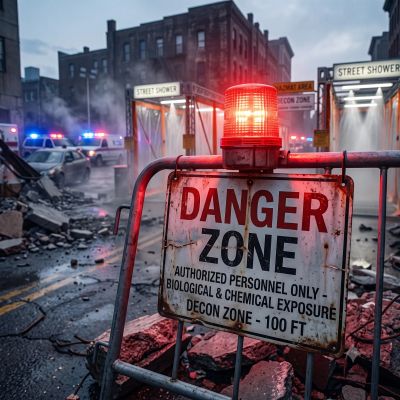
The "Rather Die Than Disrobe" Reality
To understand just how deep this software glitch runs, we have to look at how our society behaves when life and death are on the line.
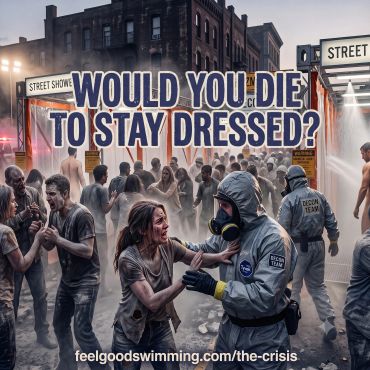
In mass casualty disaster drills conducted by federal emergency teams and public health planners simulating chemical or biological attacks, officials hit an unyielding wall of human panic. In a scenario where a crowd has been exposed to toxic contaminants, the only way to save lives is immediate, mass decontamination: dropping all clothing and walking through a public outdoor shower corridor.
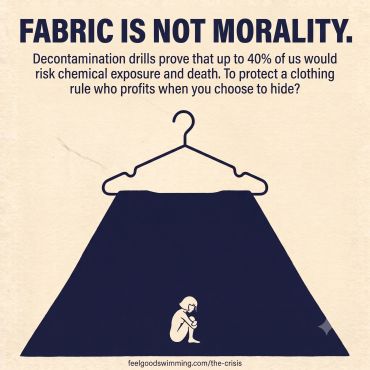
The field data revealed a terrifying truth: up to forty percent of ordinary citizens openly stated or demonstrated that they would actively refuse to undress. They chose to run back into the contaminated zone, spreading lethal toxins and allowing chemicals to burn into their own tissues, rather than stand unburdened in front of their neighbors.
Let that reality settle into the room.
Our culture has done such a thorough, aggressive job of engineering body anxiety that millions of us would literally choose a lethal dose of poison over the plain, natural baseline of human actuality. We have confused fabric with actual morality so deeply that we view our own biological skin as a greater existential threat than chemical warfare.
How did we arrive at a crossroad where a manufactured rule of compliance is worth more to us than our own survival? Who actually profits when everyday people are trained to feel so intensely compromised by their own bodies that they would choose to die in their armor?
Stripping the Weapon from the Machine
This is the point where we must take the offensive. We cannot change the reality of cameras being everywhere, and we cannot close the Pandora’s box of modern digital software. Since the machine cannot be stopped, we have to change how our culture reacts to the human form.
The traditional response to body shame has been a defensive retreat—building higher fences, retreating to secluded camps, and begging the system for isolation. But hiding accidentally validates the lie. It confirms the idea that the normal human body is a scandalous emergency that decent people shouldn't have to look at.
Safety is not engineered through better hiding places. Safety is engineered through mass public frequency.
If crossing your front door is the exact trigger that turns your own skin into a public crisis, then the threshold is what's broken, not your body. We don't need to learn how to be comfortable; we just need to stop letting an engineered system context-switch us into shame.
We are building a decentralized network of ordinary neighbors who refuse this conditioning. We are organizing a massive, disciplined public presence to reclaim our natural inherent dignity in public waters, our parks, our shared shores and other public spaces. When hundreds of ordinary people step into the water together without shame, the narrative shifts entirely from an isolated spectacle to a visible reality. We crash the market value of the taboo. We strip the camera of its ammunition, and we completely break the tool of extortion in the bully's hands.
We were born comfortable. The shame was forced on us. It is time to drop the armor, discard the discomfort, and keep the swim.
Article Memes to copy and share